CORD CLAMPING AT BIRTH RISKS HYPOXIC ISCHAEMIC ENCEPHALOPATHY
,
............................Ten Teachers 19th edition.......................................
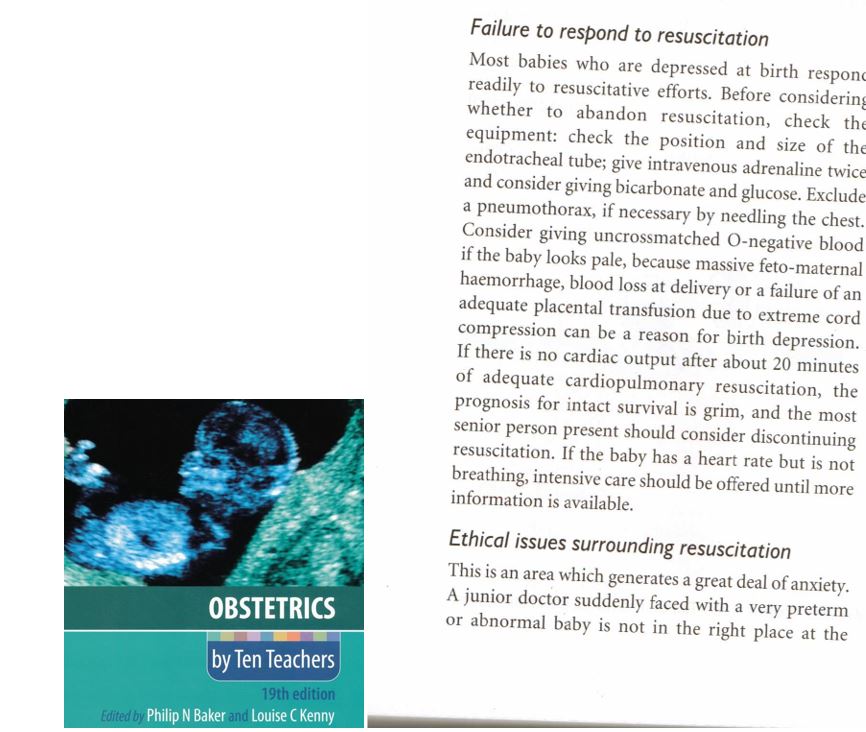
Above you can see the teaching in the 19th edition of Obstetrics by Ten Teachers. We are taught by Janet Rennie
on page 286 that failure of an adequate placental transfsuion can be a reason for birth depression.
She advises that this needs to be corrected by a transfusion of uncrossmatched
O neg blood before the baby will respond to ventilation. The 19th edition is edited by Philip Baker and Louise Kenny.
(They state that the book is written for students
preparing for the final examination, and in the hope that it will prove useful to them afterwards, and to others who have passed
beyond the stage of examination)
Here is the recommendation from the 2025 European Resuscitation Guidelines
Delayed cord clamping (DCC) --- Where immediate resuscitation or stabilisation is
not required, aim for delayed cord clamping of at
least 60 s. A longer period may be more beneficial.
Although recommendations about delayed cord
clamping have not changed significantly, there is
even more emphasis on the importance of delayed
cord clamping for all newborn infants, especially
preterm infants. In newborn infants needing
resuscitation, clamp the cord <30 s to minimise
delay to necessary interventions. MY EMPHASIS
So the 2025 guidelines are recommending that the cord is clamped before 30 seconds in order to avoid delaying
necessary interventions. BUT according to Ten Teachers this early clamping may result in a baby that fails to respond
ventilation. and may result in a baby that has a grim prognosis for intact survival.
Who is right ?
In Archives of Disease in Childhood - ADC - a highly respected journal. This article entitled Management and investigation of encephalopathy: 2017 update by
Kathryn Martinello, Anthony R Hart, Sufin Yap, Subhabrata Mitra,
Nicola J Robertson they state that "After the cord is clamped in an apnoeic infant with sustained
circulation, there is a 50% reduction in cardiac output, secondary
to the sudden increase is systemic vascular resistance and the persistence of high PVR. Cardiac output is re-established
with ventilation onset.8 For the infant who is already hypoxic, this time
before establishment of FRC could exacerbate ischaemic injury. Ventilation prior to cord clamping has been shown to ameliorate
swings in cardiac output and cerebral perfusion"
Another teaching to show how important it is to NOT clamp the cord in any
baby thought to need resuscitation.
So there is good evidence that Clamping the cord early may result in a baby that does not respond to ventilation as
the cardiovascular system has suffered an exacerbation of an ischaemic inury.
Martinello et al also state that "This would require a significant change to delivery
room practice, requiring close collaboration between obstetric
and neonatal staff" The problem of early cord clamping in an apnoeic was recognised in 2015, but there is no discussion
or mention of this in the 2025 guidelines that are clearly advising risking the hypovolaemia and exacerbation of the
ischaemic inury of the neonate that is simply not obviously breathing during the first 30 seconds after birth. There is no
advice about how practitioners should deterimine whether or not the baby is taking shallow breaths
Some of these babies who have had their cord clamped within 30 seconds of birth will be hypovolaemic having lost the majority
of the placental transfusion, and will fail to respond to PPV. Others will be suffering the exacerbation of ischaemia in the
cerebral circulation, and risk developing hypoxic ischaemic encephalopathy, HIE
The Wait for White website
a
THE PHYSIOLOGY OF TRANSITION AT BIRTH IS VERY POORLY TAUGHT?
It has been known for many years that after the baby is born there is continued blood flow through the umbilical vessels.
The umbilical vessels constrict quickly after birth (a few minutes) but the vein remains open a bit longer.(a few more minutes).
The precise times are variable but for the vast majority of babies any blood flow through the umbilical vessels stops
around five minutes. It was well recognised, when early cord clamping was actually recommended practice that a relatively
large volume of blood remained in the placenta. If cord clamping is delayed for a few minutes there is quite a small volume of
blood remaining in the placenta. Thus, when the cord is clamped quickly after birth, the baby is hypovolaemic. Cord clamping
is clearly an intervention which interferes with normal physiology. This interference is clearly not beneficial.
The Farrar et al study clearly demonstrated the volume of blood which could be trapped in the placenta by early cord clamping
and this can amount to a significant proportion of the total blood volume of the neonate.
A true physiological transition of the circulation at birth does not include any intervention. For years neonatologists
resisted the idea that they were doing more harm than good with cord clamping. Many continued to claim that early cord clamping
reduced the risk of polycythemia or the risk of neonatal jaundice. All this has been conclusively ruled out so do not beleive
tham if the say that delayed cord clamping increases the risk of jaundice or polycythemia.
Hypoxic ischaemic encephalopathy is a very serious abnormality of the cerebral circulation at birth leading
to permament injury to the brain. This is one of the commonest underlyuing causes of the lifelong condition of cerebral palsy.
Look carefully at the teaching by Prof Nicola Robertson in ADC journal -- Archives of Disease in Childhood
Management and investigation of neonatal encephalopathy: 2017 update
Kathryn Martinello, Anthony R Hart, Sufin Yap, Subhabrata Mitra,
Nicola J Robertson
Martinello and colleagues state that "After the cord is clamped in an apnoeic infant with sustained
circulation, there is a 50% reduction in cardiac output, secondary
to the sudden increase is systemic vascular resistance and the persistence of high PVR.
Cardiac output is re-established with ventilation onset. For the infant who is already hypoxic, this time
before establishment of FRC could exacerbate ischaemic injury.
Ventilation prior to cord clamping has been shown to ameliorate
swings in cardiac output and cerebral perfusion and Kluckow
and Hooper propose delaying cord clamping until after ventilation onset."
Thus Martinello and coleagues explained in 2017, EIGHT years ago, that clamping the cord in an apnoeic infanct at
birth "could" exacerbate ischaemic injury to the brain. They go on to explain that such injury can be prevented by
avoiding cord clamping until after ventilation has been established.
In OBSTETRICS by Ten Teachers 19th Edition we are taught (page ) "that most babies who are depressed at
birth respond readily to resuscitative efforts. Before considering whether to abandon resuscitation,
check the equipmnent and the position and size of the endotracheal tube; give intravenous adrenaline twice and
consider bicarbonate and glucose. Exclude a pneumothorax, if necessary by needling the chest. Consider giving
uncrossmatched O-negative blood if the baby looks pale, because massive feto-maternal haemorrhage, blood
loss at delivery or failure of an adequate placental transfusion due to extreme cord compression can be a
reason for birth depression. If there is no cardiac output after about 20 minutes of adequate
cardiopulmonary resuscitation, the prognoisis for intact survival is grim,
and the most seniour person present should consider discontinuing resuscitation.
So this well established textbookk of Obstetrics teaches that "failure of an adequate placental
transfusion due to extreme cord compression " can be the cause of the problem.
Lets look at the failure an adequate placental transfusion. This text is teaching that failure of an adequate
placental transfsuion can result in a baby that fails to respond to resuscitation until this is corrected by an
emergency blood transfusion. We are further taught that this failure of the placental transfusion can be the result
of extreme cord compression. Putting a clamp on the cord is extreme cord compression.
,
Farrar et al provided an acurate measure of the placental transfusion in Farrar D, Airey R, Law G, Tuffnell D, Cattle B, Duley L. Measuring placental transfusion for term births: weighing babies with cord
intact. BJOG 2011;118:70–75. They clearly show that at vaginal and caesarean births as much as 205 mls of blood moves from the placental compartment of the neonatal circulation to the neonatal compartment in the first few minutes after birth. If the cord is clamped immediatley after birth this volume of blood is trapped in the placenta. All these babies recieved the blood volume so none were hypovolaemic. However the study clearly shows that if the cord had been clamped quickly after birth they would have been hypovolaemic. One baby would have been deprived of 205 mls of blood. In a new born baby this is a significant proportion of the total volume of blood in the neonate.
This baby would have a marked fall in cardiac output in cardiac output and become "unconscious" with loss of muscular tone and no ability to commence breathing.
,
There is plenty of more evidecne that early cord clamping is harmful, but do we neen any more proof that early cord clamping is harmful ??
,
One problem is that the majority of babies seem to transition after early cord clamping without difficulty.
This is likely because they have only lost a relatively small volume of blood and are at the lower end of
the range of volume of the placental transfusion demonstrated by Farrar et al.
We are taught to provide this extreme cord compression in any baby who does not readily breath at birth by
clamping the cord and moving the baby over to a roomside resuscitatin trolley. The "placental transfusion" is
essentially a transfer of a volume of blood from the placenta to the neonate which takes place after birth. It occurs
mainly in the one to two minutes after birth. The volume of blood which is relocated from the placenta via the
umbilical vein to the newborn baby is quite variable ( 100 - 200mls). If the cord is clamped quickly at birth this volume
of blood is permanently trapped in the placenta. If the volume is only 100 mls then the baby can usually
compensate without difficulty. However if the volume of blood trapped in the placenta is at the upper range of
200mls, then this baby will have significant hypovolaemia and may not respond as described in Ten Teachers. In
a study by Farrar et al in 2011 of 26 babies, one baby had a placetnal transfusion of just over 200mls. Of course
this baby was fine beacuse it receiveed the blood volume but if it had had immedaitel cord clamping at birth
then it may have been apnoeic and not responded to ventilation as described in Ten Teachers.
Not only is the hypovolaemia from the loss of the placental transfusion, cord clamping at birth also results in
swings in cardiac output and cerebral perfusion together with an potential exacerbation of ischaemic injury.
The neonatal resuscitation guidelines from ILCOR consistently state that ventilation
is a priority in an apnoeic neonate. This might seem logical but it has never been subbjected
to a randomised controlled trial. Any baby that fails to breath at birth will die unless help is provided to help
it start breathing. However even a healthy baby was not breathing before it was born although is was
obtaining sufficient oxygen from the placenta via the umbilical cord. This transfer of oxygenated blood within the
umbilical vein is known to continue for several minutes after birth, so
The 2025 Guidelines from the Amereican
Introduction
Human physiology is primarily about understanding how our bodies function, and armed with this knowledge we should be able to understand
how the body responds and adapts to external events.
There can be a dispute or uncertainty about the precise way a physiological function works. There can be no dispute that a true
physiological description cannot include any outside intervention. Transition at birth from placental respiration (via the umbilical cord
circulation) into pulmonary respiration is a complex change which has to occur with relative speed. Recent practice has been to assist this
transition by clamping the umbilical cord at birth. However no matter how beneficial or otherwise this may be, this outside intervention
cannot be included in a true physiological description.
There is a lot of research underway to find ways which reduce the brian injury of hypoxic ischaemia at birth.
If cord clamping at birth was stopped, how many babies would be saved from developing hypoxic ischaemic
encephalopathy.
The neonatal resuscitation guidelines advise that resuscitation/ventilation without clamping the cord if these
facilites are available otherwise the priority is ventilation if the baby is not breathing quickly after birth.
Providing ventilation while the baby remains close to it's mother at a normal birth was described by xxxx
in the BMJ in 2008. In 2013 a customised resuscitation trolley became comercially available however it is being
used largely at the birth of preterm babies. Other trollies have emerged since and involved in randomised trials.
The resuscitation guidelines clearly clearly makes resuscitation of the neonate with an intact cord the optimal
approach but the wording and advice is weak. There is no description of the disadvantqage of early cord clamping
as described by Martinallo et al. While measuring the heart rate of the neonate is required, in practice at caesarean
section birth this is not eady to achieve within the sterile operating field. At emergency caesarean section the
the baby is often expected to need some resusciation. Unless the neonate is vigourous and breathing within
seconds after birth, the temptation is to clamp the cord quickly without even measuring the heart rate. It is
well recognised that an increasing heart rate is a sign of a recovering neonate. But this requires two accurate
heart rate measurements around 30 seconds apart. Cord palpation is the only method which can readily be carried
out within the sterile field but is well known to be unrealiable.
Cord compression in labour is well recognised to result in abnormal fetal hdeart rate and fetal distress.
It also results in a transfer of blood vlume from the fetal compartment to the placental compartment of the
circulation. Clamping the cord immediately after birth in this baby is likely to result in a significantly
hypovolaemic neonate. Even if there is little actual hypoxia or acidaemia at the moment of birth, the hypovolaemia, which
even in the best units is unliely to be corrected in under 5 minutes. During this time there will be a marked
hypoxic ischaemic circulation of the brain. the subsequent outcome will be attributed to the abnormal fetal
heart. Therefore the decision to delivery interval will be considered too long, and the cord clamping never
even considered was a factor.
Method
A range of well-known physiology and medical textbooks stocked in the hospital library were searched for a description of transition of the
neonate at birth. The description of transition of the circulation was checked to determine how the closure of the placental circulation was
achieved and whether or not an umbilical cord clamps was included in this description. Eight textbooks were found to contain the description
of physiological transition at birth.
Results and Discussion
Here is the description in the 24th edition of Ganong's Review
of Medical Physiology [1]. The description was checked to determine
whether or not it met with physiology. "Because of the
patent ductus arteriosus and formen ovale, the left heart and right
heart pump in parallel in the fetus rather than in series as they do in
the adult. At birth, the placental circulation is cut off and the
peripheral resistance suddenly rises. The pressure in the aorta rises
until it exceeds that in the pulmonary artery. Meanwhile, because the
placental circulation has been cut off the infant becomes increasingly
asphyxial. Finally, the infant gasps several times, and the lungs expand.
The markedly negative intrapleural pressure (-30 to -50 mm Hg)
during the gasps contributes to the expansion of the lungs, but other
factors are likely also involved. The sucking action of the first breath
plus constriction of the umbilical vein squeezes as much as 100mL of
blood from the placenta (The placental transfusion)".
Firstly this description does not provide any explanation for the
statement that "At birth, the placental circulation is cut off ". . . . which
is clearly a sudden event as it results in "the peripheral resistance
suddenly rising." The passive tense suggests an outside influence has
led to the placental circulation being cut off. In a normal physiological
transition there is no sudden "cut off" of the placental circulation
which usually continues for at least 120 seconds [2]. Ganong's
description states that the infant is becoming increasingly asphyxiated
however a recent investigation showed a steady rise in the cord
arterial pO2 and a similar rise in venous pO2 up to 45 seconds after
birth [2]. The sequence of events may not be fully explained in the
Ganong description but there is the implication that the sequence is in
the same order as they are described. The description therefore is at the
very least, quite confusing by stating that “constriction of the umbilical
vein squeezes as much as 100mls of blood from the placenta.†when
earlier on we are told that the placental circulation has been cut off
How has it opened up again? Even if it was open how can constriction
of the umbilical vein squeeze blood from the placenta into the baby?
The use of a cord clamp is not specified in this description but it is
difficult to find an alternative explanation for the events described. The
obvious explanation for the placental circulation being “suddenly cut
off after birth, is the cord clamp.
The first invention of the cord clamp
"A midwifery surgical clam" was published in the Lancet 111 years
ago by Edward Magennis who specifically advised that his clamp
should only be placed on the cord "when it has ceased to pulsate" [3]. The
implication is that any functional circulation within the cord has
ceased naturally before the clamp is applied.
Two other textbooks of physiology were available and the
descriptions of transition was equally distorted by including an
umbilical cord clamp [4,5]. Gray's Anatomy provides a satisfactory
description [6] providing a biochemical and physiological explanation
for the construction of the umbilical vessels. Two textbooks of
paediatrics [7-9], and one of cardiology [10] describes the cord clamp
as part of the physiological process.
At best these descriptions are confusing to a student. Physiology is a
subject taught at the start of the medical education course at a time
when subtle influences may not be apparent. Could this partly explain
the reluctance of the medical establishment to consider that applying a
cord clamp is a medical intervention, while not clamping the cord (or
at least delaying clamping for several minutes until its function has
appeared to cease), is close to the normal physiological event. Many
clinicians fail to appreciate that early cord clamping is an intervention.
Current research in preterm neonates should regard the physiological
norm to be delayed cord clamping [11] and the clinical practice of
early cord clamping permitted only if a benefit for the neonates is
eventually shown in the research.
Physiological descriptions of transition must reflect a true
physiological process. If cord clamping is considered to be important, a
description of the physiological adaption to the intervention should be
clearly explained. 25th edition of Ganong published January 2016
provides a true physiological description.
References
1. Ganong Review of Medical Physiology (2012) In: Barrett KE, Barman
SM (eds). Circulation through special regions (24thedtn). McGraw Hill
Medical, New York.
2. Wiberg N, K, Olofsson P (2008) Delayed umbilical cord clamping
at birth has effects on arterial and venous blood gases and lactate
concentrations. BJOG 115: 697-703.
3. Magennis E (1899) New Inventions. Midwifery Surgical Clamp. ÃÂe
Lancet May 20: 1373.
4. Berne RM and Levy MN (1996) Principles of Physiology (2ndedtn).
Mosby, St Louis: 349.
5. Lindsay DT (1996) Functional Human Anatomy. Mosby, St Louis: 447.
6. Standring S (2005) Gray's anatomy: ÃÂe anatomical basis of clinical
practice.(41stedtn) Elsevier Churchill, Livingstone, Edinburgh: 1052.
7. Mc Millan JA (1999) Osakis Pediatrics (3rdedtn). Lippincott Williams
and Wilkins, Philadelphia: 286.
8. Behrman RE, Klieghman RM, Jenson HB (2004) Nelson’s Textbook of
Pediatrics (17thedtn) Saunders, Philadelphia: 1479.
9. Campbell AGM, McIntosh N (1998) Forfar and Arneils Textbook of
Pediatrics (5thedtn) Churchill Livingstone New York, Edinburgh:
106-107.
10. Braunwald E, Zipes DP, Libby P (2001) Heart Disease, A Textbook of
Cardiovascular Medicine (6thedtn) Saunders Philadelphia: 1512.
11. APTS: Australian Placental Transfusion Study (APTS) ClinicalTrials.gov
David J R Hutchon MPhil, BSc, MB, ChB, FRCOG
Emeritus Consultant Gynaecologist, Memorial Hospital, Darlington, England.
Altirkawi K. Therapeutic hypothermia in neonatal encephalopathy: current challenges and future prospects. Academia Medicine 2025;2.
This article ust out is very interesting.
The author states
Typically, HIE results from a significant reduction in oxygen (hypoxia) and/or blood flow (ischemia) to the fetal or neonatal brain,
often occurring during labor, delivery, or the immediate postnatal period. This insult initiates a complex biphasic pattern of
brain injury, which unfolds over time and contributes to neuronal mortality and neurodevelopmental impairment [2].
In an article by Martinello et al in ADC in 2017 (Martinello K, Hart AR, Yap S, et al. Arch Dis Child Fetal Neonatal Ed 2017;102:F346–F358) they state "After the cord is clamped in an apnoeic infant with sustained circulation, there is a 50% reduction in cardiac output, secondary to the sudden increase is systemic vascular resistance and the persistence of high PVR. Cardiac output is re-established with ventilation onset.8 For the infant who is already hypoxic, this time before establishment of FRC could exacerbate ischaemic injury. Ventilation prior to cord clamping has been shown to ameliorate swings in cardiac output and cerebral perfusion,
Even in low resource settings the fetal heart will have been monitored usually by doppler ultrasound. Cord compression is a
common cause of intrapartum asphyxia and heart rate abnormalities. Cord compression reduces the oxygenated blood in the
umbilical vein returning to the fetus and contributes to the asphyxia. The arteries however remain uncompressed and the
flow out to the placenta remians normal. The difference in the flow rates results in an increased volume of blood in the
placenta and a reduced volume I the fetal compartment of the feto-placental circulation. The cord compression is usually
intermittent so there is a fluctuation in the proportion of blood between the placental and fetal compartments. At and after
birth, with relief of the cord compression, the blood volumes normalise and then there is a physiological transfer of blood
volume from the placenta to the fetal compartment - called the placental transfusion.
However as Martinello points out if the cord is clamped quickly at birth and especially before the baby has started to breathe
and the pulmonary circulation has been established, there is an acute hypoxic ischaemic period which no doubt at least
exacerbates any hypoxic ischaemic injury to the brain. This can be avoided by avoiding cord clamping before the lungs have
been inflated and also the neonatal blood volume returned to normal by the transfer of the placental transfusion during the
first few minutes after birth.
No doubt early cord clamping at birth in an already asphyxiated neonate will contribute to the development of HIE.
This is essentially iatrogenic. Stopping early cord clamping will not prevent all HIE but it must reduce the risk
significantly.
Very often in both high resource and low resource setting the condition of the baby at birth is not sufficiently carefully
determined before the cord is clamped. This is especially true when there has been fetal distress and there is anxiety to
ensure neonatal resuscitation is commenced as soon as possible. The heart rate and its response after birth is the best
determinant of the state of the baby. If the heart rate is normal and the baby is not immediately breathing does it
really need ventilation instantly. If the heart rate is determined by auscultation it is likely to be very inaccurately
determined. The ECG seems to be the best and ofcourse the results are documented for later audit and review. But it takes
time to set up and can only be done at CS if the cord has been clamped and the baby moved over to the resuscitaire.
The NeoBeat is a significant improvement and Anup Kateria tells me it can be sterilised for use at CS births.
Another approach which I have been working on it a hands—free neonatal doppler ultrasound. see attached MPhil thesis.
As doppler is already available in low resource settings, the standard fetal doppler can also be used , and put inside a
sterile polythene sheath at CS births.
In 2005 I became aware if the problem of cord clamping and the harm to the baby and have been working on this since.
In 2013 we developed the LifeStart trolley which is a mobile resuscitation trolley allowing all the facilitedds of the standard
resuscititaire on a trolley small and mobile enough to provide motherside neonatal resuscitation. See attached.
The Baby Lifeline is the same concepts for low resource settings.
The cost and effort of treating HIE is enormous so purely on economic grounds any way of preventing it needs to be thoroughly
investigated.
From Farrar D, Airey R, Law G, Tuffnell D, Cattle B, Duley L. Measuring placental transfusion for term births: weighing babies with cord
intact. BJOG 2011;118:70–75.
The direct measurement of placental transfusion by weighing babies at birth with the cord intact suggests that the
mean volume is between 83 and 110 ml, equivalent to 24–32 ml per kilogram of birth weight. Typically, placental
transfusion represents between one-third and one-quarter of the potential blood volume at birth. There is considerable variation between individual babies, with a few infants
receiving relatively small volumes of placental transfusion whilst others received quite large volumes. For most
infants, placental transfusion appeared to be complete by 2 minutes, but, for some, it continued for up to 5 minutes.
All these babies had their placental transfusion and all were perfectly healthy. BUT if they had had the cord clamped immediately
after birth they would have been hypovolaemic by the equivalent of 24 -32mls per kg. For a 3.5 Kg baby that is the loss of
112 mls. In a baby already compromised by hypoxia and having to deal with transitin from placental to pulmonary respiration,
the loss of this volume of blood could be critical. It might be sufficient to prevent a satisfactory response to PPV and
lead to a dead baby or a baby with hypoxic ischaemic encephalopathy - HIE. Delaying PPV before clamping the cord might
increase the hypoxia but it will not contribute to any further ischaemia or reduction in the circulation, while clamping
the cord soon after birth will certainly reduce the blood volume. The blood volume which is lost as a result of early
cord clamping is unknown in any individual neonate so if significant hypovolaemia is suspected, the actual blood volume needed
is uncertain. Over transfusion can be as harmful as undertransfusion. The ERC guideline recommends in the absence of
suitable blood (i.e.group O Rh-negative blood), isotonic crystalloid rather than albumin is the solution of choice for restoring intravascular volume and to give
a bolus of 10 mL kg 1 initially. The Farrar study showed immediate cord clamping results in a loss of 24 to 32 mls per kilogram
so an attempt to replace this lost blood with only 10mls per kilogram is going to be insufficient in the majority of babies. While
delaying PPV during delayed cord clamping might increase hypoxia but the flow of oxygenated blood from the placenta continues
for several minutes in the unclamped cord and the flow could increase if any cord compression is relieved.
Why do most babies apparently cope with early cord clamping (when it was recommended practice) ? Clearly these babies are extremely
robust and by constricting less essential parts of the neonatal circulation the cerebral circulation is maintained.
Ofcourse this does not justify the intervention and for a few babies, as explained above, clamping the cord quickly after
birth can be critical.
No further research is needed although there is a need for a lot of training and practice to optimise the appraoch. BUT
early cord clamping needs to stop NOW.